
Nurse Practitioner Collaborative Agreements in New Jersey

Table of Contents

Low


Meeting Requirements

Board submissions

Distance Restrictions
New Jersey NP collaboration is now split between exempt and non-exempt APNs. On March 30, 2026, New Jersey signed S2996/A4052, making independent practice permanent for certain APNs who provide primary or behavioral health care and allowing qualifying APNs to prescribe without a joint protocol with a collaborating physician.1
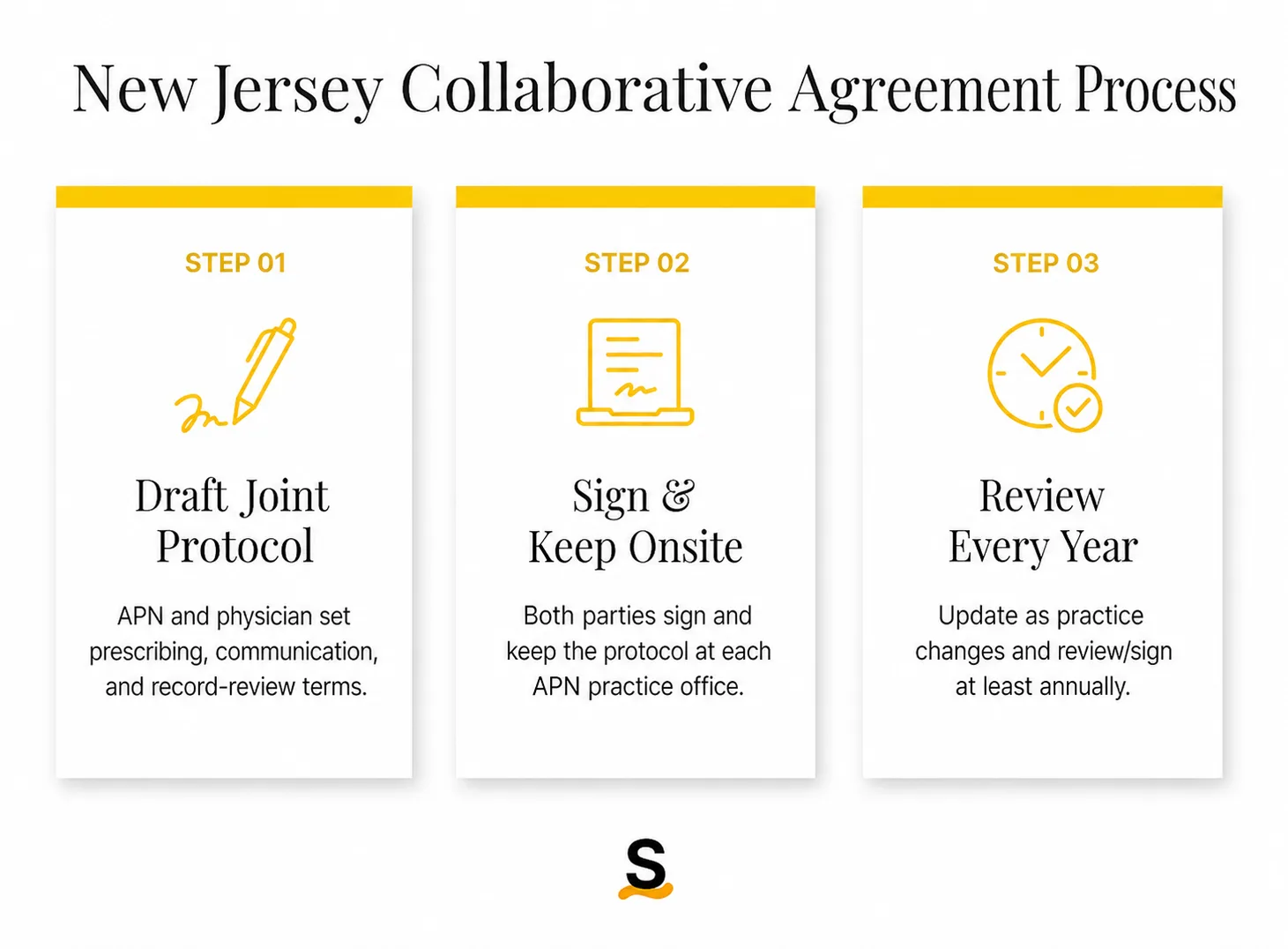
APNs who do not qualify for the exemption, or who practice outside the covered primary or behavioral health settings, should still use a written joint protocol when prescribing or ordering medications or devices. For those APNs, New Jersey rules require the protocol to be written, signed, kept at each APN practice office, updated as practice details change, and reviewed at least annually.2
Citations
1. New Jersey Governor press release on S2996/A4052; S2996/A4052 Senate Committee Substitute bill statement.
2. N.J.A.C. 13:37-8.1.
.jpg)
.jpg)
Submitting the Agreement to the State
New Jersey no longer has one uniform joint-protocol answer for every APN. On March 30, 2026, New Jersey signed S2996/A4052, making independent practice permanent for certain APNs who provide primary or behavioral health care and allowing qualifying APNs to prescribe medications without a joint protocol with a collaborating physician.1
The exemption is tied to criteria such as more than 5,000 hours of licensed, active advanced nursing practice and the type of care being provided. APNs who do not qualify for the exemption, or who practice outside the covered primary or behavioral health care settings, should still use a written joint protocol when prescribing or ordering medications or devices.2
Where a joint protocol is still required, New Jersey rules require it to be written, signed, kept at each APN practice office, updated as practice details change, and reviewed at least annually; the rule does not list a routine Board filing or approval step for the joint protocol itself.3
Citations
1. New Jersey Governor press release on S2996/A4052, March 30, 2026.
2. S2996/A4052 Senate Committee Substitute bill statement.
3. N.J.A.C. 13:37-8.1.
Collaboration & Supervision Requirements
Prescriptive Authority (Medications & Controlled Substances)
Scope of Practice


.svg)


.svg)






About the Author


.png)