
Chart review sounds like a small administrative question until you try to run a practice around it.
In Tennessee, a nurse practitioner may need a supervising physician to review a defined percentage of charts every 30 days.1 In California, the same basic compliance idea may live inside standardized procedures and internal review policies instead of a state-mandated chart count.2 Both clinicians can be following the rules. They are just operating under very different rules.
That is the problem this article is trying to make legible. For NPs and PAs launching a practice, chart review affects how the collaborating physician agreement is written, how charts are sampled, and what documentation needs to exist if a board, malpractice carrier, employer, or payer asks questions later. For collaborating physicians, it affects the amount of oversight work they are actually agreeing to do.
The state rules fall into a few practical groups. Some states name both a chart percentage and a review frequency. Some name a frequency but leave the volume open. Some require review to be defined in the agreement, protocol, QA plan, or care-team process. And some do not appear to impose a statewide chart-review requirement at all.
The table below is meant to make that first pass easier: find your state, see the basic structure of the requirement, then use the cited source language to confirm what applies to your license, practice setting, and agreement.
What is a chart review, and why does it exist
A chart review is a structured review of patient records from an NP or PA's practice. In most states that require it, the reviewer is a collaborating or supervising physician. The reviewer is not re-treating every patient. They are looking for patterns: whether the diagnosis fits the note, whether the treatment plan is documented, whether prescribing decisions make sense, whether follow-up is clear, and whether anything should be discussed with the clinician.
That last part matters. Chart review is often treated like a paperwork requirement, but the actual purpose is oversight. A defensible review process creates a record that someone looked at the clinical work, identified issues when needed, and closed the loop. In states with physician collaboration or supervision rules, that documentation may be the practical evidence that oversight is happening.
The exact form varies. In one state, review may mean a set percentage of charts every month. In another, it may mean periodic random chart review. In another, the agreement may simply require the parties to define a review process. Some states focus less on charts and more on QA meetings, case discussion, prescribing patterns, or controlled-substance audits.
This is also why chart review still matters in states with fewer formal requirements. The NP workforce is large and growing. AANP's 2025 count includes more than 461,000 licensed NPs in the United States, and BLS projects nurse practitioner employment to grow 40% from 2024 to 2034. More clinicians are practicing across more settings, including independent and small-practice models. That creates more need for clean internal systems: who reviews charts, how often they review them, what they look for, and where the review is documented.
The risk argument is simpler than the legal one. If a chart is ever questioned by a board, payer, employer, malpractice carrier, or plaintiff's attorney, the practice needs more than a verbal assurance that someone was "checking in." It needs a process that can be shown after the fact.
Who owns the chart review process?
The physician is usually the reviewer, but the process has to be built around the clinician's records. In practice, chart review works one of two ways: the physician gets appropriate access to the EHR, or the clinician exports the selected charts and shares them through a HIPAA-compliant channel.
From there, the workflow is fairly concrete. The practice identifies the required sample of charts. That sample may come from the state rule, the collaborative agreement, the prescriptive authority agreement, or an internal QA policy. The physician reviews each chart, leaves chart-level notes where needed, and writes broader feedback for the clinician. Some feedback can be handled asynchronously. Other issues are better discussed in the next scheduled meeting.
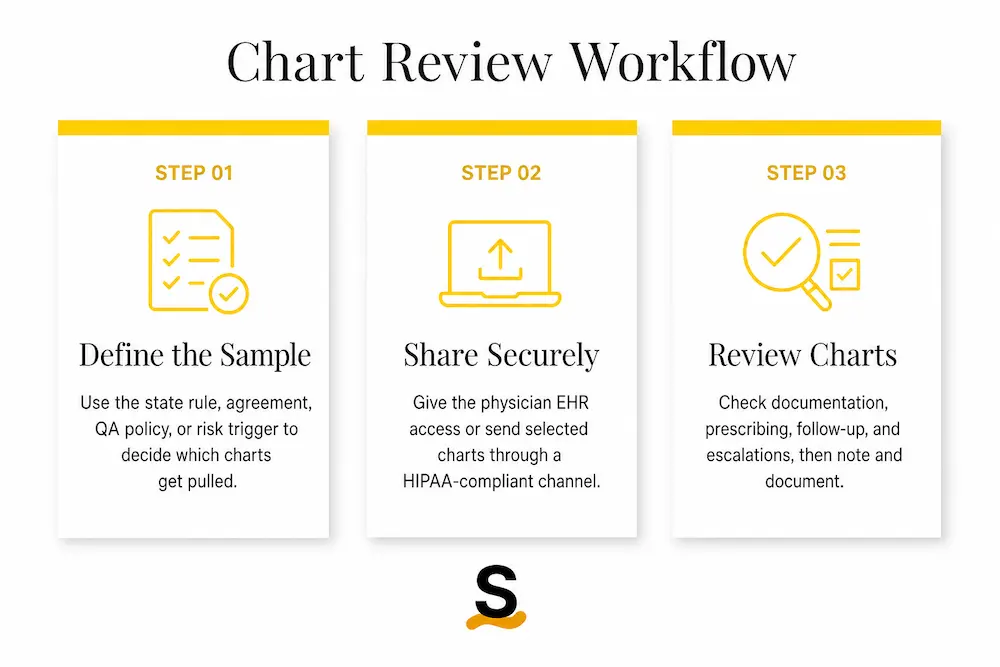
The details matter more than the label. A good chart review process needs a secure way to share charts, a place to save the review record, and a clear rule for which charts get pulled. If the state requires 20% every 30 days, the sample has to be built around that. If the agreement says 5% monthly, the practice should be able to show how that 5% was selected. If the rule calls out controlled substances, adverse outcomes, Schedule II prescribing, or other higher-risk charts, those charts need to be flagged instead of buried in a random sample.
The record should also show the loop closing. It is not enough to say the physician had EHR access or that charts were available for review. The practice should be able to show which charts were reviewed, when review happened, who reviewed them, what notes were left, and whether any follow-up discussion occurred. That is what turns chart review from a vague oversight promise into a process that can survive a board question, payer audit, or malpractice review.
Chart Review Checklist
This is where many arrangements break down. The agreement may say "periodic chart review," but no one defines the sample. The physician may be willing to review charts, but the clinician never sends them in a usable format. The clinician may export charts, but the files move through ordinary email or disappear after the meeting. None of those failures are dramatic. They are ordinary workflow gaps. They are also exactly the gaps that make chart review hard to prove later.
Chart review requirements by state
The main pattern is that only a small group of states give practices a clean math problem. Most states do something less direct.
For this article, we are using four operating categories:
- Explicit percentage + frequency: the state names both how many charts must be reviewed and how often review must happen. States: Georgia, Indiana, Missouri, Tennessee.
- Explicit frequency only: the state sets a review interval, but does not set the number or percentage of charts. States: New York, Ohio.
- Agreement-defined: the state requires some form of review, but leaves the exact percentage and frequency to the agreement. States: Alabama, Arkansas, California, Connecticut, Illinois, Kentucky, Louisiana, Michigan, New Jersey, North Carolina, Oklahoma, Pennsylvania, South Carolina, Texas, Virginia, West Virginia.
- No set requirement: the state does not set a general chart-review percentage or frequency. A practice may still have employer, payer, malpractice, or internal QA requirements. States: Colorado, Florida, Wisconsin.
This is why the operational burden can feel so uneven. Tennessee tells the practice to review 20% of charts every 30 days. New York sets a quarterly record-review requirement but does not name a chart count. Texas requires a quality assurance process where the number of charts is determined by the physician and APRN. Those are very different workflows, even though all three are usually described as "chart review."
Frequently asked questions
Does my state require chart reviews?
It depends on the state. Some states set a percentage and frequency, some set only a frequency, and some leave the percentage and frequency to the agreement. If the state does not set a chart-review requirement, check the signed agreement, employer policy, malpractice carrier, payer contract, and internal QA requirements.
For many practices, a voluntary 5-10% sample is a reasonable starting point, especially when prescribing is part of the practice. The exact number should reflect the clinician's scope, patient volume, risk profile, and any agreement or payer requirements.
What percentage of charts must be reviewed?
There is no national percentage. The required amount depends on the state and, in many states, the signed agreement.
Some states set a fixed percentage. Tennessee requires at least 20% of charts every 30 days,1 while Indiana requires at least a 5% random sample of charts and medications within seven days.10 Other states set a review frequency but no percentage. New York, for example, requires patient-record review at least every three months, but does not set a chart count.16 In agreement-defined states, the percentage should be written into the agreement or review process.
If your state does not set a percentage, the percentage should come from the agreement or another practice requirement, such as a payer rule, malpractice carrier expectation, or internal QA policy.
What happens if I do not comply with my state's chart review rule?
If chart review is required by state rule, the practice should be able to show that the review happened; failure to follow the rule can become a board issue for the clinician, the collaborating physician, or both. If chart review is required by the agreement, skipping it means the parties are not following the agreement they signed. If a malpractice claim later raises questions about supervision or documentation, missing chart-review records may also make the arrangement harder to defend.
The practical fix is to document the process before there is a problem: the sample, the date, the reviewer, the notes, and any follow-up. That record is what shows the review actually happened.
Find a collaborating physician who actually reviews
Knowing the rule is only useful if the collaboration is set up to follow it. A physician who signs an agreement but does not review charts, leave notes, or make time for follow-up creates the same operational problem the requirement was supposed to solve.
Single Aim helps NPs connect directly with collaborating physicians and set expectations around the work up front: chart access, secure file sharing, review frequency, chart-level notes, and follow-up. That matters in states with explicit review percentages, and it matters in agreement-defined states where the percentage and frequency need to be written into the arrangement.
If you are setting up a new agreement or replacing a physician who is not doing the review work, build the review process into the collaboration from day one.
Citations
- Tenn. Comp. R. & Regs. 0880-06-.02(8)
- Cal. Code Regs. tit. 16, § 1474(b)(11)
- Ala. Admin. Code r. 610-x-5-.09(5), (8)
- Ark. Code Ann. sec. 17-87-310; 17 CAR sec. 123-603
- 3 CCR 716-1, Rule 1.14(C)(9), (13)-(15)
- Conn. Gen. Stat. sec. 20-87a(b)(2)-(3)
- Florida Board of Nursing APRN protocol materials and Florida Board of Nursing APRN FAQ
- Ga. Comp. R. & Regs. 360-32-.02(8)(a)
- 68 Ill. Admin. Code secs. 1285.335(b), 1300.430(b)(4)
- 848 Ind. Admin. Code 5-1-1(a)(7)(F)
- Ky. Rev. Stat. sec. 314.042(15)(l)(2)-(3)
- Louisiana State Board of Medical Examiners, Joint Statement of Position (Jan. 2016)
- Mich. Comp. Laws sec. 333.16109(2); Mich. Admin. Code R. 338.2411(2)
- Mo. Code Regs. tit. 20, sec. 2200-4.200(3)(E)
- N.J. Admin. Code sec. 13:37-8.1(c), (b)
- N.Y. Educ. Law sec. 6902(3)(a); 8 NYCRR sec. 64.5(a)(3)
- 21 NCAC 36.0810(4)-(5); N.C. Gen. Stat. sec. 90-18.2
- Ohio Admin. Code 4723-8-05(C); 4723-8-04(D)-(E)
- Okla. Admin. Code sec. 435:10-13-2(b)
- Pennsylvania Professional Nursing Law sec. 212(13); 49 Pa. Code secs. 21.251, 21.285(a)(4)
- S.C. Code Ann. sec. 40-33-34(D); South Carolina Board of Nursing APRN FAQ
- Tex. Occ. Code sec. 157.0512
- 18 VAC 90-30-120; Va. Code sec. 54.1-2957(D), (I)
- W. Va. Code sec. 30-7-15b(c); W. Va. Code R. 19-8-3.1.f.2
- Wis. Admin. Code N 8.10(7)
Sources
- AANP, A Behind-the-Scenes Look at the 2025 Nurse Practitioner Count
- AANP, State Practice Environment
- AAPA, PA Practice Modernization
- U.S. Bureau of Labor Statistics, Nurse Anesthetists, Nurse Midwives, and Nurse Practitioners: Occupational Outlook Handbook
Find Collaboration Opportunities
.png)


Find Collaborating Physicians


.png)